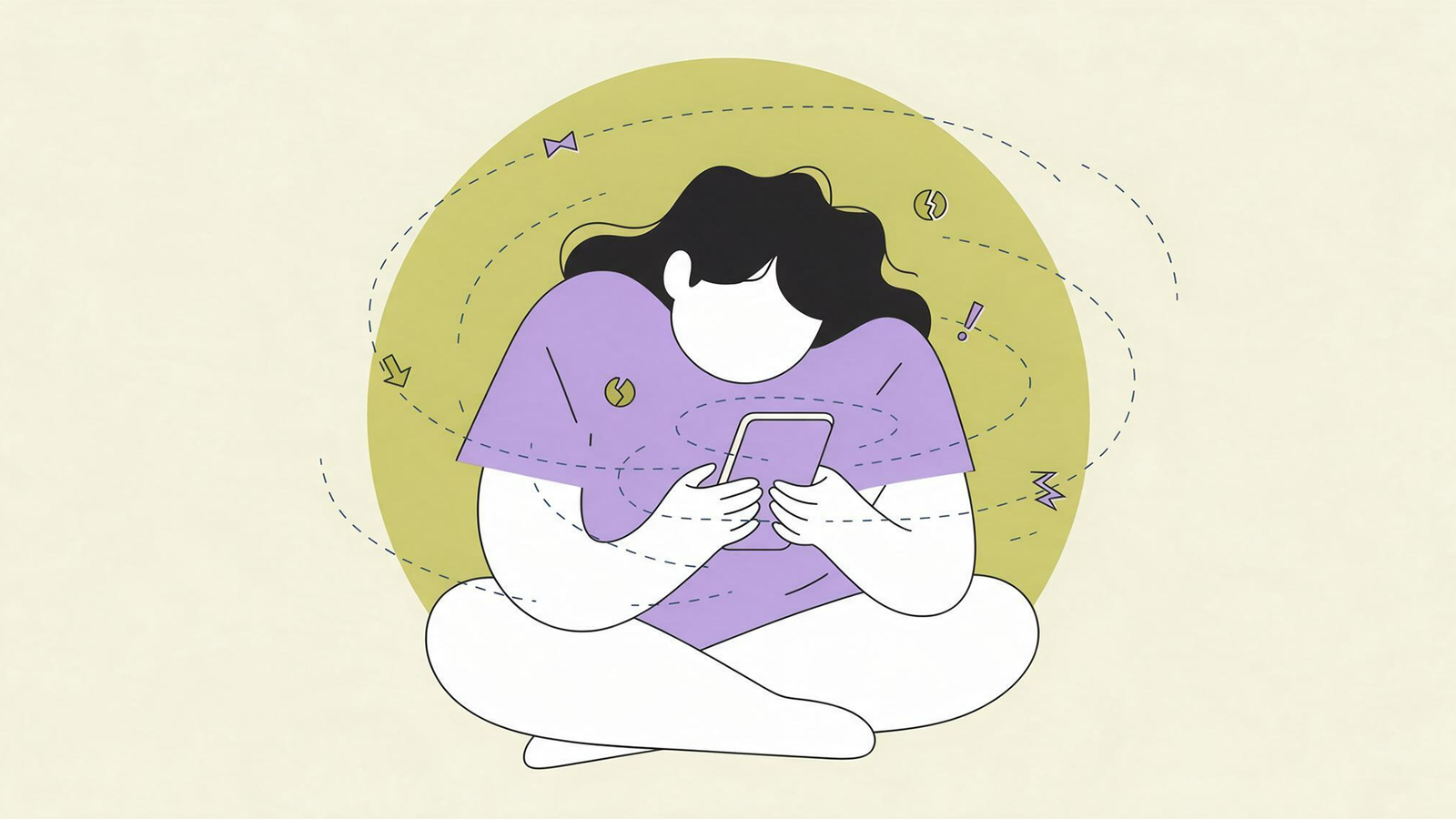
It is 1 AM, and you told yourself you would put the phone down twenty minutes ago. Instead, you are three headlines deep into a crisis on the other side of the world, then a comment section, then another headline. You feel worse than when you started, and yet the thumb keeps moving. This is not a willpower failure. It is a brain doing exactly what it evolved to do, in an environment engineered to exploit that.
Learning how to stop doomscrolling starts with understanding why it happens at all. A 2025 UC San Diego interview with psychiatry professor Susan Tapert explains the mechanism plainly: negativity bias, an evolutionary survival trait, makes the amygdala treat threatening information as urgent and keep scanning, while the brain’s reward circuit releases dopamine every time something new appears on screen. Threat-scanning plus a reward loop produces a scroll that does not end on its own. This blog covers what is actually driving the habit, what it costs, and how to stop doomscrolling in a way that holds up past the first few days.
Negativity Bias Brain: Why Bad News Wins
The negativity bias brain mechanism is not a modern glitch. It is an old survival tool operating in a completely new environment, and understanding it is the real starting point for how to stop doomscrolling rather than just white-knuckling through screen time limits.
Reporting on the neuroscience of doomscrolling, Business Standard cites Dr Astik Joshi, a child, adolescent, and forensic psychiatrist, who describes how doomscrolling lights up the same dopamine reward circuitry involved in addictive behaviours. Every unpredictable headline or breaking update delivers a small dopamine hit, comparable to pulling the lever on a slot machine. Layer that reward loop on top of a negativity bias brain that treats threatening information as more urgent than neutral or positive content, and the two systems team up against you: one keeps you scanning for danger, the other keeps rewarding you for finding it.
Doomscrolling Addiction: Is That the Right Word?
Calling it doomscrolling addiction is not an exaggeration for effect. A 2026 clinical review from DopaBrain describes doomscrolling as running on the same variable-ratio reinforcement schedule that powers slot machines: most content is unremarkable, but occasionally something is genuinely activating, which is precisely what keeps the behaviour compulsive rather than merely habitual.
The defining features of doomscrolling addiction are consistent across the clinical literature: continuing to scroll even when you consciously want to stop, feeling progressively worse the longer the scroll continues, and a distorted sense of how much time has actually passed. None of these is moral failings. They are the predictable output of a system specifically engineered to produce them, and it is exactly why how to stop doomscrolling needs more than good intentions.
Effects of Doomscrolling on Mental Health
The effects of doomscrolling on mental health extend well past the immediate discomfort of a bad news cycle.
- Elevated anxiety and a persistent, low-grade sense of dread that does not resolve when the phone goes down
- Disrupted sleep, driven partly by screen exposure and partly by cortisol elevation from repeated threat activation
- Emotional exhaustion without a corresponding increase in genuine understanding or insight
- A creeping sense of helplessness, since most doomscrolled content describes problems the reader cannot act on
Research cited in a review of doomscrolling psychology found that doomscrolling predicts existential anxiety and pessimism specifically, because users internalise constant negativity without gaining any clarity or workable solutions from it. The feeling of being plugged in and informed is often not matched by any actual increase in useful knowledge.
If bad news has started to feel like the only thing your mind can hold onto, that pattern is worth addressing directly, not just managing around. The Therapy Park offers therapy for anxiety, compulsive digital habits, and the nervous system patterns underneath them, in Kolkata and online across India.
Doomscrolling and Anxiety: A Two-Way Street
The relationship between doomscrolling and anxiety runs in both directions. Anxious people are more likely to doomscroll, searching for certainty or control in an uncertain situation. And doomscrolling itself generates more anxiety, closing the loop.
A narrative review examining doomscrolling among young adults found that algorithm-driven recommendation systems and infinite-scroll interfaces are specifically designed to maximise repeated exposure to negative content. This matters because it reframes doomscrolling and anxiety as something shaped by the interaction between individual psychology and engineered technology, not simply an individual self-regulation failure to be solved through willpower alone.
Breaking the Doomscrolling Habit: What Actually Works
Genuine strategies for breaking the doomscrolling habit work with the underlying brain mechanisms rather than fighting them through sheer discipline.
- Add friction, not just intention: Log out of apps between uses, move them off the home screen, or use a greyscale display. The goal is to interrupt the automatic reach for the phone, since willpower alone consistently loses to a well-designed habit loop.
- Time-box news consumption: Set a specific, limited window for checking news rather than allowing it to be available at every idle moment. This works with the negativity-bias brain rather than expecting it to switch off simply.
- Use the swap technique: When the urge to scroll hits, substitute a different, brief action, stepping outside, texting someone, a few minutes of a physical task, rather than trying to suppress the urge through willpower alone.
- Keep the bedroom phone-free: Doomscrolling in bed compounds both the sleep disruption and the anxiety loop. A charging station outside the bedroom removes the easiest, most tempting access point.
- Use mindfulness to interrupt the amygdala response: Research on mindfulness-based techniques, including brief breathing exercises, shows measurable reductions in compulsive digital behaviour by directly calming the threat-detection response that drives the scroll.
If none of the usual advice about screen time limits has actually stuck, that is often because the pattern is doing something for the nervous system, not just the schedule. The Therapy Park offers therapy that addresses both the anxiety and the habit loop together in Kolkata and online across India.
Frequently Asked Questions
Why can’t I stop doomscrolling even when I want to?
Two brain systems work against you simultaneously. Your negativity bias brain treats threatening headlines as urgent and keeps you scanning, while the dopamine reward circuit reinforces every new piece of information you find. Together, they produce a loop that willpower alone struggles to interrupt, which is why learning how to stop doomscrolling usually requires changing the environment, not just the intention.
Is doomscrolling actually a real addiction?
Clinically, doomscrolling addiction shares the same reward mechanisms as other compulsive behaviours, including a variable reinforcement schedule similar to slot machines. It produces continued use despite a conscious desire to stop, along with a progressively worsening emotional state, both hallmarks of addictive patterns.
What are the biggest effects of doomscrolling on mental health?
The most consistently documented effects of doomscrolling on mental health include elevated anxiety, disrupted sleep, emotional exhaustion, and a growing sense of helplessness, since much of the content consumed describes problems the reader has no way to act on directly.
What is the fastest way to start breaking the doomscrolling habit?
The most effective first step in breaking the doomscrolling habit is adding friction rather than relying on willpower: logging out between sessions, moving apps off the home screen, and keeping the bedroom phone-free. These changes work with the brain’s automatic reward-seeking rather than trying to overpower it through discipline alone.
Final Thoughts
Doomscrolling is not evidence of weak willpower. It is a negativity bias and a dopamine reward system doing exactly what they evolved to do, inside an environment specifically engineered to exploit both. Learning how to stop doomscrolling means working with that biology, through friction, boundaries, and intentional substitution, rather than fighting it through sheer intention alone.
At The Therapy Park, therapy for anxiety, compulsive scrolling, and the nervous system patterns that keep both going is available with practitioners who understand the mechanisms involved. In-person in Kolkata and online across India.